
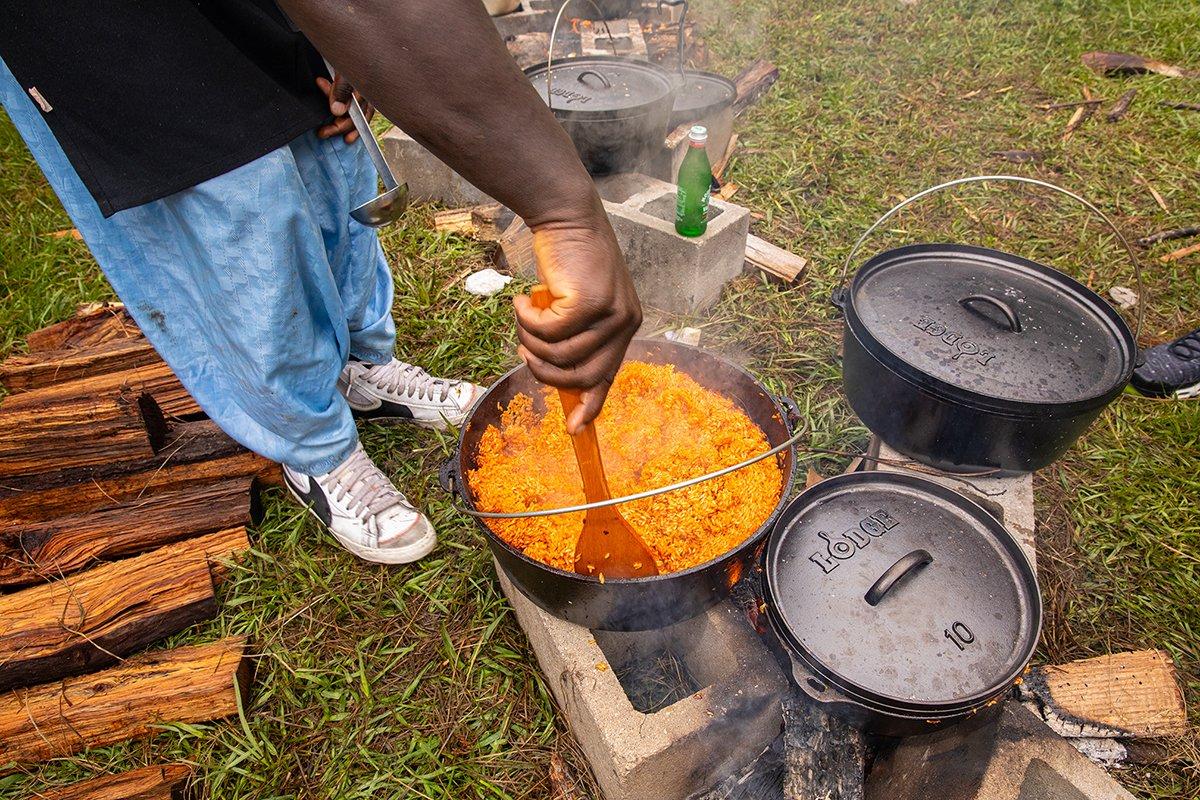


The Ottawa Jollof Festival is a Nigerian/African cultural festival built around jollof rice, African food, music, fashion, dance and community. Although jollof is the central attraction, the organizers deliberately positioned the event as something broader than simply a food festival—a platform for Africans, particularly Nigerians in the Ottawa area, to come together and showcase their culture.
The first edition took place on Sunday, August 31, 2025, at Andrew Haydon Park in Ottawa, running from 2 PM to 8 PM with free admission. (Eventbrite)
Interestingly, the 2026 edition has expanded considerably. It is scheduled for August 22–23, 2026, at Jacques-Cartier Park in Gatineau, across the Ottawa River from Ottawa, and is again advertised as free admission. (ottawajolloffestival.org) BUY THE TICKET NOW


The fascinating origin of the festival
The story behind the festival is actually quite interesting because it wasn’t the result of years of planning.
The festival was conceived by Nigerian filmmaker and creative entrepreneur Niyi Akinmolayan after he spent some time in Ottawa.
According to Akinmolayan’s own account, he noticed that Nigerians in Ottawa were working hard and living busy lives, but there wasn’t a sufficiently large platform where the Nigerian community could come together in a major celebration of its culture.
He essentially asked:
How do Nigerians in Ottawa come together outside the smaller gatherings they already attend?
His answer was to create a major cultural festival.
Akinmolayan explained that he didn’t initially want to create something that would simply be called a food festival. Instead, he wanted food to be the vehicle for something bigger—community, culture, entertainment and connection.
Then he asked himself which food could represent Nigerian/African culture globally.
His answer was obvious:
🍚 Jollof.
He subsequently contacted his friend Ibitoye, who became involved in the project, while Akinmolayan persuaded Beevar Homes, a real-estate company, to sponsor the event. (LinkedIn)
Akinmolayan’s own website describes him as the creator/director of the Ottawa Jollof Festival and says the festival is intended as a cultural platform built around shared experiences. (withniyi.com)
⏱️ The incredible part: it was organized in about 3 weeks
This is probably one of the most remarkable things about the festival’s origin.
According to Akinmolayan’s account, the first festival was put together in only about three weeks.
Within that extremely short period, the organizers had to:
- secure the venue
- obtain permits
- create the festival identity and logo
- develop promotional materials
- recruit vendors
- contact community organizations
- approach the media
- organize performers
- develop family and children’s activities
- arrange a fashion show
- organize a jollof competition
- coordinate volunteers
- engage the Nigerian High Commission
- and promote the event.
He says they contacted more than 40 community organizations, conducted press outreach, and even appeared on CTV. (LinkedIn)
And perhaps most importantly, the organizers made a strategic decision:
Admission would be free.
Instead of making attendees pay at the gate, they planned to create enough value for food and other vendors that vendors would pay to participate.
That became an important part of the festival’s business model. (LinkedIn)
🍛 Why Jollof Rice?
This is where the festival gets particularly clever from a cultural-marketing perspective.
Jollof isn’t exclusively Nigerian.
The dish has deep roots in West Africa, and its history is commonly connected to the Senegambian region and the Jolof/Wolof Empire, particularly areas associated with present-day Senegal and Gambia.
Over time, different West African countries developed their own versions.
Today, the most famous rivalry is probably:
🇳🇬 Nigeria vs 🇬🇭 Ghana
Who makes the best jollof?
That friendly rivalry has become part of West African popular culture.
The Ottawa festival therefore chose a food that could simultaneously represent:
- Nigerian identity
- West African culture
- African diaspora
- food entrepreneurship
- cultural pride
- friendly competition
- and international curiosity.
The first Ottawa festival even included a Jollof competition between vendors. (LinkedIn)
So the festival isn’t really saying “jollof belongs exclusively to Nigeria.”
It is using jollof as a cultural bridge.
🇳🇬 Was the Ottawa Jollof Festival originally a Nigerian event?
Primarily, yes.
The first event was strongly Nigerian in its identity and programming.
The 2025 festival included:
- Nigerian food
- Nigerian music
- cultural performances
- African fashion
- Nigerian vendors
- a traditional Nigerian monarch
- a jollof competition
- African products and services.
A report from Black Ottawa Scene described the first festival as an event bringing Nigerian culture to Canada’s national capital. (Black Ottawa Scene)
But the vision has always been bigger than Nigeria.
The official festival description talks about African food, music and culture, and the 2026 event promotes exposure to multiple African cultures. (ottawajolloffestival.org)
👥 What happened at the first festival?
The inaugural event on August 31, 2025 attracted hundreds of people to Andrew Haydon Park.
According to Black Ottawa Scene, attendees experienced:
Food
- Jollof rice
- African cuisine
- food vendors
Entertainment
- Nigerian traditional music
- dance
- live performances
Culture
- Nigerian traditional royalty
- African fashion
- cultural displays
Business
- African-themed vendors
- products and services
The event also attracted people outside the Nigerian community, including non-Africans who came to experience the food and culture. (Black Ottawa Scene)
Eventbrite records 548 total attendees for the 2025 event. (Eventbrite)
🤝 The deeper purpose: building community
This is probably the most important part of the festival’s origin.
Akinmolayan’s explanation wasn’t simply:
“Ottawa needs a jollof festival.”
His underlying observation was that Nigerians in the diaspora need spaces where they can reconnect with one another and publicly express their culture.
The festival therefore combines three things:
1. Food
Jollof becomes the common language.
2. Entertainment
Music, dancing and fashion make the event attractive to younger people and families.
3. Identity
Nigerians and other Africans get an opportunity to see their culture represented publicly.
This is why the festival can attract both Africans and non-Africans.
For Nigerians, it can feel like home away from home.
For other Canadians and visitors, it becomes an introduction to African culture.
💰 The business model is also interesting
There is a valuable entrepreneurial lesson in how the first festival was created.
The organizers wanted free admission for guests, but a large festival obviously costs money.
Instead of relying entirely on ticket sales, they created value for vendors.
The logic was essentially:
More people → more customers for vendors → vendors are willing to pay for participation → visitors can enter free.
Akinmolayan said that convincing vendors initially was difficult, but once they demonstrated the potential value, the vendor spaces filled up.
He reported that by seven days before the event, the vendor slots were full, and on the day of the festival, vendors sold out—some reportedly selling more than three times their expected volume. (LinkedIn)
That is an excellent example of event monetization through ecosystem value rather than entrance fees.
🚀 From 2025 to 2026
The growth between the first and second editions is significant.
2025
One day
- August 31
- Andrew Haydon Park
- Ottawa
- 2 PM–8 PM
- Free admission
2026
Two days
- August 22–23
- Jacques-Cartier Park
- Gatineau
- Free admission
- African food, music and culture
- broader cultural representation.
The official 2026 website promotes the festival around “Food, Music, Culture” and advertises participation from 50+ cultures. (ottawajolloffestival.org)
That suggests the festival is evolving from a primarily Nigerian community event into a much broader African cultural platform in the National Capital Region.
🌍 Why the festival is significant
I think the Ottawa Jollof Festival is interesting for a reason beyond jollof.
It represents something increasingly important within the African diaspora:
Using culture as a community-building and economic tool.
The festival simultaneously creates opportunities for:
African restaurants
→ sell food to thousands of people.
Food entrepreneurs
→ introduce their brands to new customers.
Fashion designers
→ showcase African fashion.
Musicians and performers
→ reach a multicultural audience.
African businesses
→ promote their products and services.
Immigrants
→ reconnect with their culture.
Young Africans born abroad
→ experience their heritage.
Non-Africans
→ discover African culture.
That makes the festival much more than a plate of jollof.
🇳🇬 And there’s an important Nigerian angle
The festival’s Nigerian foundation is particularly significant because Nigerians have one of the strongest and most visible African diaspora communities in Canada.
The organizers recognized something very simple:
Nigerians don’t need much convincing to gather around food, music and celebration.
The challenge is creating the platform.
And that is essentially what Akinmolayan did.
He took an observation about the Nigerian community in Ottawa, selected one of the world’s most recognizable West African dishes, built a festival around it, made entry free, brought businesses and cultural performers into the ecosystem, and managed to launch the first edition in roughly three weeks. (LinkedIn)
Today, that experiment has grown into a two-day 2026 festival. (ottawajolloffestival.org)
One important distinction
There are many Jollof festivals around the world, and jollof itself has a much older West African history. The Ottawa Jollof Festival is a relatively new event, beginning in 2025. So it would be inaccurate to describe the festival itself as an old Nigerian tradition. Rather, it is a modern diaspora cultural event inspired by an old West African culinary tradition.
If you’re interested, I can also dig much deeper into Niyi Akinmolayan’s background, how he funded/organized the first festival, the vendors and winners of the 2025 Jollof competition, attendance, sponsors, media coverage, and exactly how the festival grew into the 2026 edition.
